
Kinesiology Taping That Supports Your Recovery Between Visits
Flexible, comfortable support for injured muscles and joints that moves with you — applied for your specific injury and used alongside the active care that rebuilds lasting strength.
What Kinesiology Tape Is — and What It Isn’t
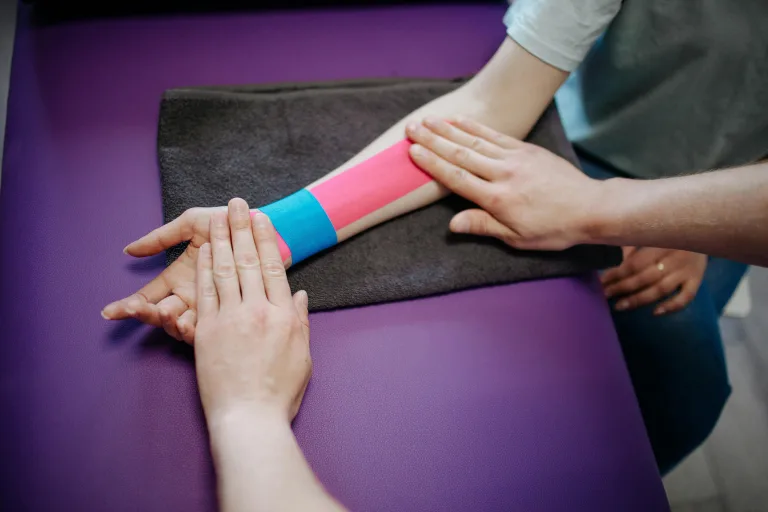
Kinesiology tape is a thin, elastic tape designed to stretch much like your skin. Unlike rigid athletic tape, it supports muscles and joints without locking them in place, so you can keep moving normally while you wear it.
Applied with specific direction and tension, the tape provides gentle support and feedback to the area. Many patients find it eases pain and helps them move and exercise more comfortably during recovery, and it can usually be worn for several days at a time.
Taping is a supportive tool, not a stand-alone fix. We use it to help you get more out of your adjustments, shockwave therapy, and exercise program — the treatments that address the underlying problem.
Common Taping Applications
We customize each application to your injury, your activity, and your stage of recovery.
Neck & Upper Back
- Whiplash and post-accident stiffness
- Posture-related neck and shoulder tension
- Upper back muscle strain
Low Back
- Muscle strain and spasm
- Pain with sitting or bending
- Support during early rehab
Shoulder
- Rotator cuff irritation
- Pain reaching overhead
- Shoulder blade control
Elbow & Wrist
- Tennis or golfer’s elbow
- Forearm strain from gripping
- Repetitive work strain
Knee
- Pain around the kneecap
- Patellar tendon pain
- Support for stairs and squats
Foot & Arch
- Plantar fasciitis heel pain
- Arch fatigue
- Achilles tendon irritation
Getting the Most From Your Tape
A few simple habits help your tape stay comfortable and effective, and protect your skin.
- Wear time — most applications can be worn for several days; we’ll tell you how long for yours.
- Showering — tape can usually get wet. Pat it dry afterward rather than rubbing it.
- Skin check — remove the tape if you notice itching, burning, redness, or a rash.
- Removal — peel slowly in the direction of hair growth while pressing down on the skin; a little oil helps.
- When to skip it — taping isn’t used over open wounds, fragile or irritated skin, or with a known adhesive allergy. If you have diabetes or reduced sensation, we’ll discuss it first.
Taping at a Glance
Overcome. Perform. Empower.
A structured, three-phase plan with a clear goal at every step — so you always know where you are in your recovery.
Overcome
Tape helps support irritated tissues and ease discomfort while your adjustments and early treatment calm pain.
Perform
Support during exercise and return to activity, so you can train with more comfort and confidence.
Empower
As your strength returns, you’ll need tape less — and we’ll teach you simple applications if they still help during activity.
Evidence-Based Use of Kinesiology Taping
Research on kinesiology taping is mixed, so we use it where the evidence fits best: as a short-term addition to active care. A 2026 meta-analysis of randomized trials in tennis elbow found that taping combined with exercise produced better short-term improvements in pain, function, and grip strength than sham taping or exercise alone (reference).
A meta-analysis of 15 randomized trials in myofascial pain found taping reduced pain intensity, particularly in the immediate and short term, with effects fading over time — which is why we pair it with treatments that build lasting change (reference).
Pain Relief Support
Applications designed to ease discomfort short-term so you can move and exercise more comfortably.
Posture Feedback
Gentle tension that cues better positions during work and daily tasks.
Activity Support
Taping for training, sport, and return to work without restricting your motion.
Functional Exercise
Taping works best alongside progressive exercise that rebuilds strength.
Chiropractic Care
Tape can help maintain comfort and support between adjustments.
Focused Shockwave Therapy
Support for tendons and soft tissue between shockwave sessions.
When to Remove Your Tape
Remove the tape right away if you notice itching, burning, a rash, blistering, increased pain, or new numbness or tingling, and let us know at your next visit. Seek medical care for a severe skin reaction, or for swelling, warmth, and redness that spreads.
Kinesiology Taping FAQs
Does kinesiology tape actually work?
Research shows taping can provide short-term pain relief and support for some conditions, especially when combined with exercise. It isn’t a cure on its own, which is why we use it as part of a complete care plan.
How long can I wear it?
Most applications can be worn for several days. We’ll tell you how long to keep yours on and when to remove it.
Can I shower or swim with the tape on?
Usually, yes. Kinesiology tape is designed to handle water. Pat it dry afterward instead of rubbing, which helps it stay in place.
Is it the same as athletic tape?
No. Traditional athletic tape is rigid and limits motion. Kinesiology tape is elastic and supports the area while letting you move normally.
Can I apply it myself?
For some areas, yes. If taping continues to help during activity, we can teach you simple applications to use at home.
Where are you located?
We’re at 1203 Jacaranda Blvd., 2nd Floor at Venice Healthpark, Venice, FL 34292 — convenient to patients from Venice, Nokomis, Osprey, North Port, and Englewood.
Ready for Support That Moves With You?
Schedule an evaluation with Dr. Jordan Sanderson in Venice, FL.
(941) 201-0206