

Why Your Muscles Tighten After an Injury (And Why That’s Not the Whole Problem)
If you’ve ever been in a car accident, thrown out your back lifting something, or woken up unable to turn your neck, you already know the feeling. Your muscles don’t just hurt. They lock up. They feel rigid, guarded, almost defensive. That’s because they are.
Muscle spasm and chronic tightness aren’t random malfunctions. They’re your body doing exactly what it’s designed to do. Understanding why your muscles behave this way is often the first step toward actually resolving the pain, rather than just chasing it.

Your Muscles Are a Defense System
When tissue is injured, whether it’s a disc, a ligament, a joint capsule, or the muscle itself, your nervous system’s first priority isn’t comfort. It’s protection. The body responds to injury the same way it would respond to a threat: it restricts movement around the damaged area so you can’t make things worse.
This shows up as involuntary muscle guarding. The surrounding musculature contracts and stiffens, effectively splinting the injured region the way a cast might stabilize a broken bone. It’s not a malfunction. It’s a reflex, coordinated by the nervous system, built to limit further damage while healing takes place.
The problem is that this protective response doesn’t always turn itself off when it should.
When Protection Becomes the Problem
In an acute injury, guarding is temporary and useful. But when the underlying tissue damage isn’t properly addressed, or when the nervous system stays on high alert long after the initial injury, that same protective tightness can become chronic. The muscles keep bracing against a threat that, biomechanically, may no longer exist in the same way, but the nervous system hasn’t gotten the message.
This is where a lot of patients get stuck. The tightness itself becomes a major source of ongoing pain, restricted motion, and fatigue, separate from and often outlasting the original injury. Chronically guarded muscle tissue develops trigger points, loses normal blood flow, and compensates by pulling on joints in ways they weren’t built to tolerate. What started as a smart, short term defense mechanism turns into a long term contributor to dysfunction.
There’s a useful way to think about the difference between healthy and chronically guarded muscle, and it’s one that even elite athletes have built entire recovery systems around. Tom Brady has talked at length about the concept of muscle “pliability,” the idea that healthy muscle tissue should be soft, long, and able to absorb force efficiently. Tight, chronically contracted tissue, by contrast, is dense and short, and it absorbs force poorly, which makes it more prone to injury and slower to recover. It’s the same basic principle we see clinically every day, just applied on a football field instead of after a collision. Muscle that’s stuck in a defensive, guarded state simply doesn’t function the way it’s supposed to, whether you’re trying to plant and throw a football or just trying to turn your head to check a blind spot.
What We See Clinically
This pattern is one we see constantly in practice, and it shows up especially clearly after motor vehicle accidents. Car accidents remain one of the most common sources of the kind of sudden, forceful trauma that triggers this exact chain of events. The body absorbs an unexpected force, the nervous system responds with protective muscle guarding, and that guarding often persists long after the collision itself.
Having worked with thousands of patients presenting after motor vehicle accidents, a consistent pattern emerges. The muscles around the neck, shoulders, and back stay braced well past the point where the original tissue has started to heal. Patients often describe feeling like they’re “stuck” or “wound up,” even when imaging and exams show the initial injury settling down. That persistent tightness isn’t imagined. It’s the nervous system still running a protective program that needs to be actively addressed, not just waited out.

Addressing the Cause, Not Just the Tightness
Because muscle guarding is a nervous system response, effective treatment has to work on more than just the muscle tissue itself. In our office, we approach it from a few directions at once.
Adjustments restore normal motion to joints that have become restricted, which helps reduce the mechanical irritation that keeps triggering the protective response in the first place.
Targeted exercise retrains the surrounding musculature and helps the nervous system relearn that the area is stable and safe to move, which is often what’s needed to finally turn off a guarding pattern that’s outlived its usefulness.
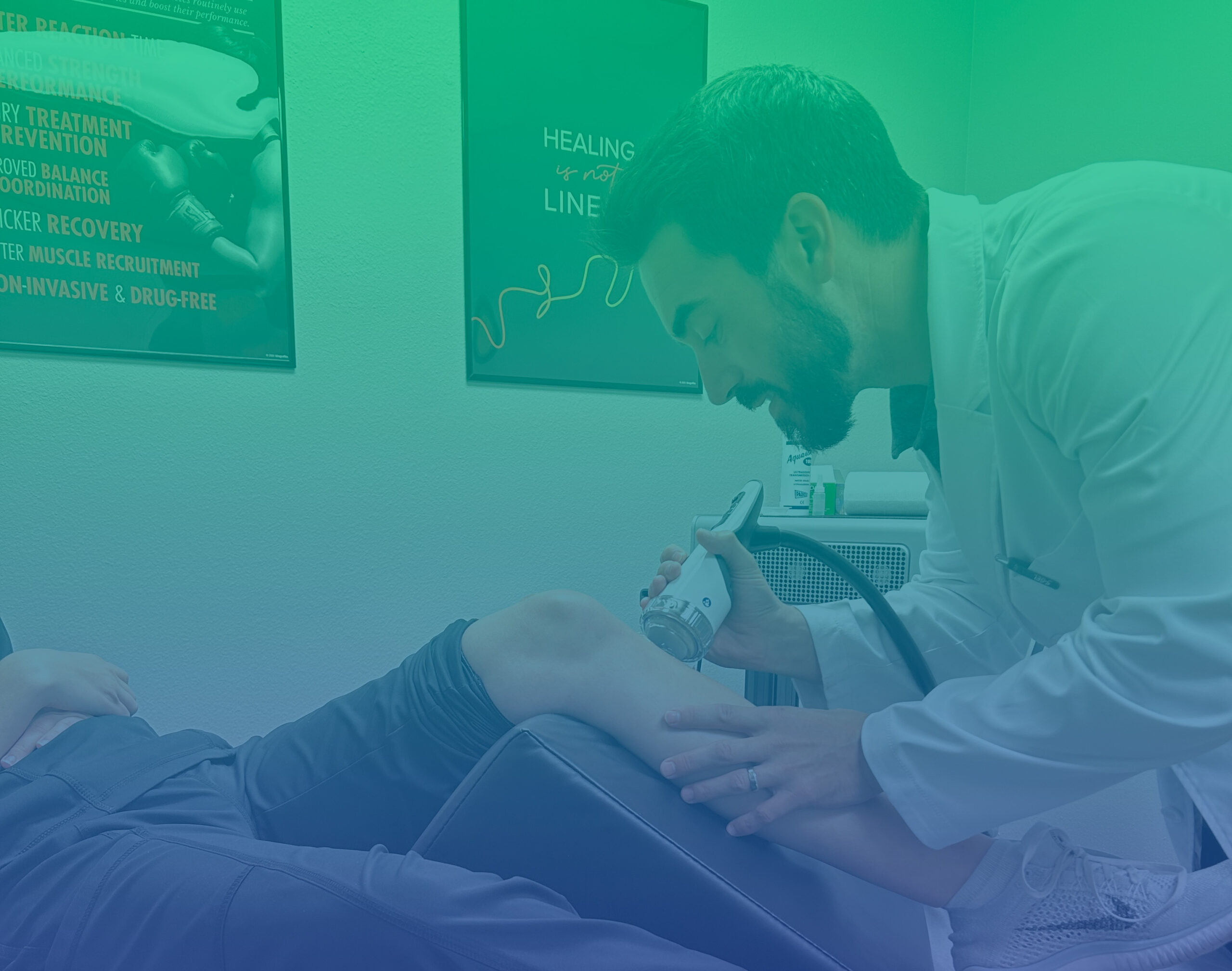
Focused shockwave therapy works directly on the chronically tight, fibrotic tissue itself, improving blood flow and breaking up the patterns of tension that have built up in the muscle over time. In other words, helping that tissue move back toward the kind of soft, pliable state it’s supposed to be in.
Used together, these approaches address both sides of the equation. The joint mechanics that may still be feeding the protective response, and the muscle tissue that’s been left in a guarded state longer than it needs to be.
The Takeaway
Muscle tightness after an injury isn’t a sign that something is wrong with your body’s design. It’s a sign that your body’s design is working. The issue is that a defense system built for short term protection can become a long term source of pain when it isn’t given the right input to stand down.
If you’ve been dealing with tightness that hasn’t resolved on its own, especially following a car accident or other trauma, it’s worth having that pattern evaluated rather than just stretched, iced, or waited out. Understanding what your muscles are actually doing is the first step toward getting them to stop.

Leave a Reply