


Degeneration Isn’t Decay: What’s Really Happening Inside a “Degenerated” Spine
Why bone spurs, endplate sclerosis, and facet hypertrophy are signs of your spine building, not falling apart.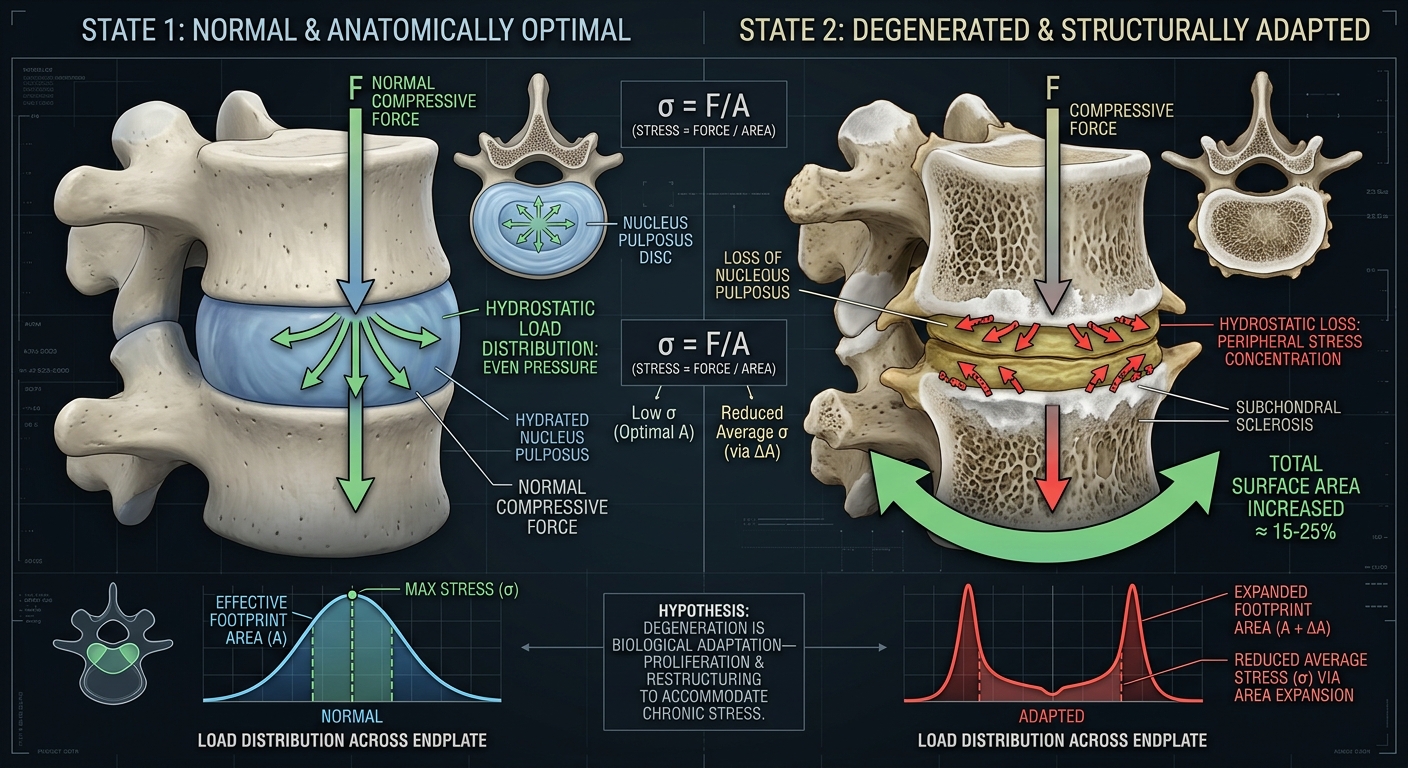
If you’ve had an MRI or X-ray of your lower back and heard the word “degeneration,” you’ve probably pictured something wearing down — like brake pads thinning, or a hinge rusting out. It’s an understandable mental image. It’s also, in a very real sense, backwards.
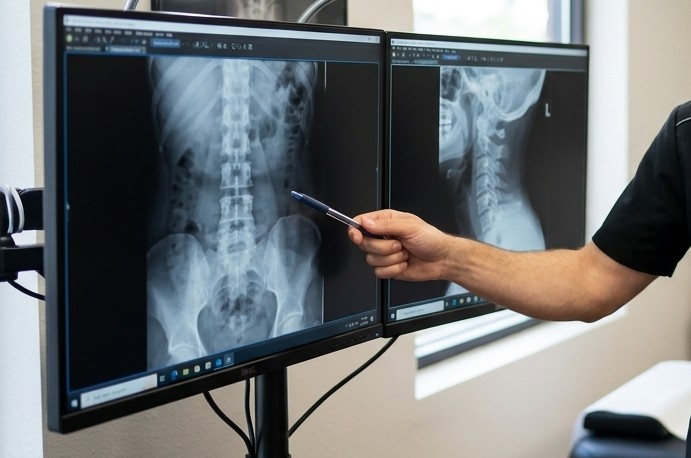
I personally review every MRI our patients bring in, and over years of doing that, a pattern became impossible to ignore: a lot of what we call “degeneration” isn’t your spine losing structure. It’s your spine building more of it — just in a different shape than it started with.
The word “degeneration” is misleading
Clinically, degeneration refers to a group of changes we see on imaging: disc height loss, bone spurs (osteophytes), thickened and hardened endplates (sclerosis), and enlarged facet joints (facet hypertrophy). The name suggests a structure that’s failing. But look closely at what each of those findings actually is, and a different picture emerges:
- Osteophytes are new bone. Your body is building them, not losing them.
- Endplate sclerosis is bone becoming denser and more compact — not thinner.
- Facet hypertrophy is literally the word “hypertrophy” — enlargement, not shrinkage.
Three of the hallmark signs of a “degenerated” spine are, on close inspection, signs of bone growth. That’s worth sitting with.
Your bones respond to load — that’s not a flaw, it’s a feature
This isn’t a new or fringe idea. It’s a well-established biomechanical principle called Wolff’s Law: bone remodels itself in response to the mechanical demands placed on it. It’s the same reason a weightlifter’s bones densify and a bedridden patient’s bones thin. Bone is living tissue, constantly reading how much load it’s under and rebuilding accordingly.
When a disc loses height or hydration over time, the load it used to carry doesn’t disappear — it transfers somewhere else. Some of it shifts onto the vertebral endplates and the small joints in the back of the spine (the facet joints). Those structures start carrying more than they were originally built for, in ways they weren’t originally shaped for.
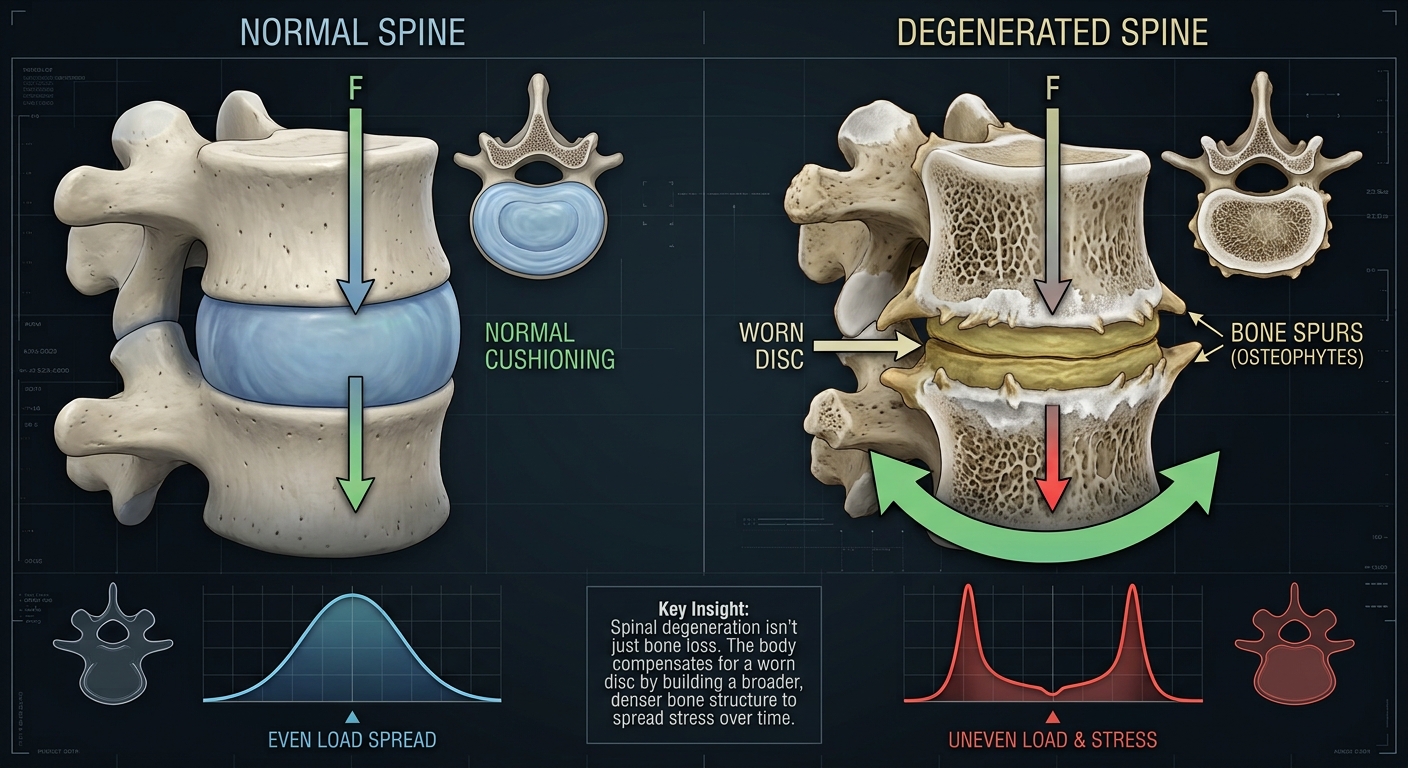
The bone responds the way bone always responds to increased, uneven demand: it builds. More surface area. More density right at the point of stress. A broader base to spread the new load across. That’s not the structure failing. That’s the structure adapting.
So why does “more bone” cause problems?
This is the part patients usually want to understand, and it’s a fair question — if the body is building more bone, why does that hurt?
The issue usually isn’t the amount of bone. It’s where it ends up and how that changes the way the joint moves. Bone laid down to reinforce a stressed segment can:
- Narrow the space where a nerve exits the spine
- Restrict how freely a joint can move through its normal range
- Shift how load gets shared with the segments above and below it
In other words, the adaptation is protective in intent, but it can change the mechanics of the area enough to create new problems — stiffness, restricted motion, nerve irritation — even while it’s technically doing its job of reinforcing an overloaded structure.
Why this reframe matters for how we treat it
If degeneration were truly just decay — bone disappearing, structure failing — the honest conversation would mostly be about managing decline. That’s not the conversation we have here.
If degeneration is adaptive restructuring in response to how load has been moving through your spine, then the more useful question becomes: can we influence how that load moves?
That’s the foundation of how we approach care. Rather than treating the joint as a structure that’s simply wearing out, we look at restoring more even, more functional movement through the segment — with the goal of reducing the abnormal stress that’s driving the bone to keep remodeling in ways that crowd nerves and restrict motion. It’s the same logic behind our three-phase approach:
Overcome
Address the pain and the mechanical restriction driving the current stress pattern
Perform
Restore functional movement and load distribution through the segment
Empower
Build the strength and mechanics that keep load moving evenly, long term
You’re not fighting a spine that’s falling apart. You’re working with a spine that’s been compensating — and helping it find a better way to carry the load.
The bottom line
“Degeneration” is a clinical word, not a life sentence, and it doesn’t mean your spine is disintegrating. In most cases we’re not looking at a structure in decline — we’re looking at bone that has spent years reinforcing itself against uneven demand. Understanding that changes the goal of care: not just managing decline, but restoring the mechanics that let your spine stop having to overbuild in the first place.
If you’ve seen the words “degenerative changes,” “osteophyte,” or “facet hypertrophy” on your own imaging report and want to understand what’s actually happening at your specific levels, that’s exactly the kind of conversation we have in a consultation — walking through your own images together, not just a generic report summary.


Leave a Reply